What Is Perimenopause? Age, Stages and How Long It Lasts
Quick answer: Perimenopause is the transition leading up to menopause, when your ovaries gradually wind down and your hormones start to fluctuate. It most often begins in your 40s, though it can start in your late 30s. It lasts about four years on average, and it ends at menopause: 12 months in a row without a period.
The word itself explains a lot. "Peri" means "around," so perimenopause literally means "around menopause." Yet many women have never heard the term until they're already in it. That's changing fast: online searches for "perimenopause" have risen sharply in the past few years as more women look for words to describe what's happening to them.
Here's what perimenopause means, what age it starts, how long perimenopause lasts, and what your hormones are actually doing along the way.

What is perimenopause, exactly?
Perimenopause is the natural phase between your regular reproductive years and menopause. During perimenopause, your ovaries still release eggs and make hormones, but less predictably than before. Periods keep coming, often with changes in timing, flow or length.
Three terms are often mixed up, so it helps to keep them straight:
Perimenopause: the transition years, when hormones fluctuate and periods become irregular.
Menopause: a single point in time, reached after 12 consecutive months without a period. In the US, the average age is about 51.
Postmenopause: every year after that point.
So when someone says "I'm going through menopause" in her mid-40s, she usually means perimenopause.
What's happening to your hormones in perimenopause?
Perimenopause isn't a smooth, steady decline. It's more like a bumpy ride:
Progesterone often drops first. As ovulation becomes less regular, your body makes less progesterone, the hormone that steadies the second half of your cycle and supports sleep.
Estrogen swings up and down. In early perimenopause, estrogen can actually run higher than usual some months, then dip sharply in others.
FSH rises, unevenly. Your brain sends stronger signals (follicle-stimulating hormone) to coax the ovaries along, but levels vary widely from cycle to cycle.
These swings, more than low hormone levels alone, explain why perimenopause can feel so unpredictable. It's also why a single blood test usually can't confirm perimenopause: a "normal" result on one day says little about the next.
Perimenopause age: when does it start?
For most women, perimenopause starts in their 40s, most often in the mid-40s. Some notice changes in their late 30s. Because menopause arrives at about 51 on average, and perimenopause usually runs several years before it, the early 40s are a very common starting point.
A few factors can shift your perimenopause age earlier:
Family history: the age your mother or sisters reached menopause is often a useful clue.
Smoking: linked with reaching menopause about one to two years earlier.
Medical treatments: chemotherapy, pelvic radiation, or surgery on the uterus or ovaries.
Menopause before age 40 is called premature ovarian insufficiency, and before 45 is considered early menopause. Both deserve a medical evaluation, because they can affect bone and heart health over time.
The stages of perimenopause: early vs. late
Clinicians often describe perimenopause in two stages, based mainly on how your cycle changes:
Stage | What usually changes | Common experiences |
Early perimenopause | Cycle length starts to vary by a week or more from one cycle to the next | Heavier periods, worse PMS, sleep changes, new anxiety or irritability |
Late perimenopause | Skipped periods, with gaps of 60 days or more between them | Hot flashes and night sweats become more common, along with vaginal dryness and brain fog |
Not everyone moves through the stages the same way, and some women notice very few changes until late perimenopause.

How long does perimenopause last?
Perimenopause lasts about four years on average, but the range is wide: a few months for some women, close to ten years for others. It's officially over once you've gone 12 months without a period.
Some symptoms don't stop on that date, though. Hot flashes and night sweats often continue into postmenopause. A large US study (SWAN) found that frequent hot flashes and night sweats lasted a median of 7.4 years in total.
Common signs of perimenopause
The most reliable early sign of perimenopause is a change in your menstrual cycle: periods coming closer together or further apart, heavier, lighter or skipped. Alongside that, many women notice:
Hot flashes and night sweats
Waking at 2 or 3 a.m.
New anxiety, irritability or low mood
Brain fog and fatigue
Joint aches and weight shifting to the middle
Vaginal dryness and lower libido
For the full list, see our 15-point perimenopause symptom checklist, or take the free Whole-Picture Check.
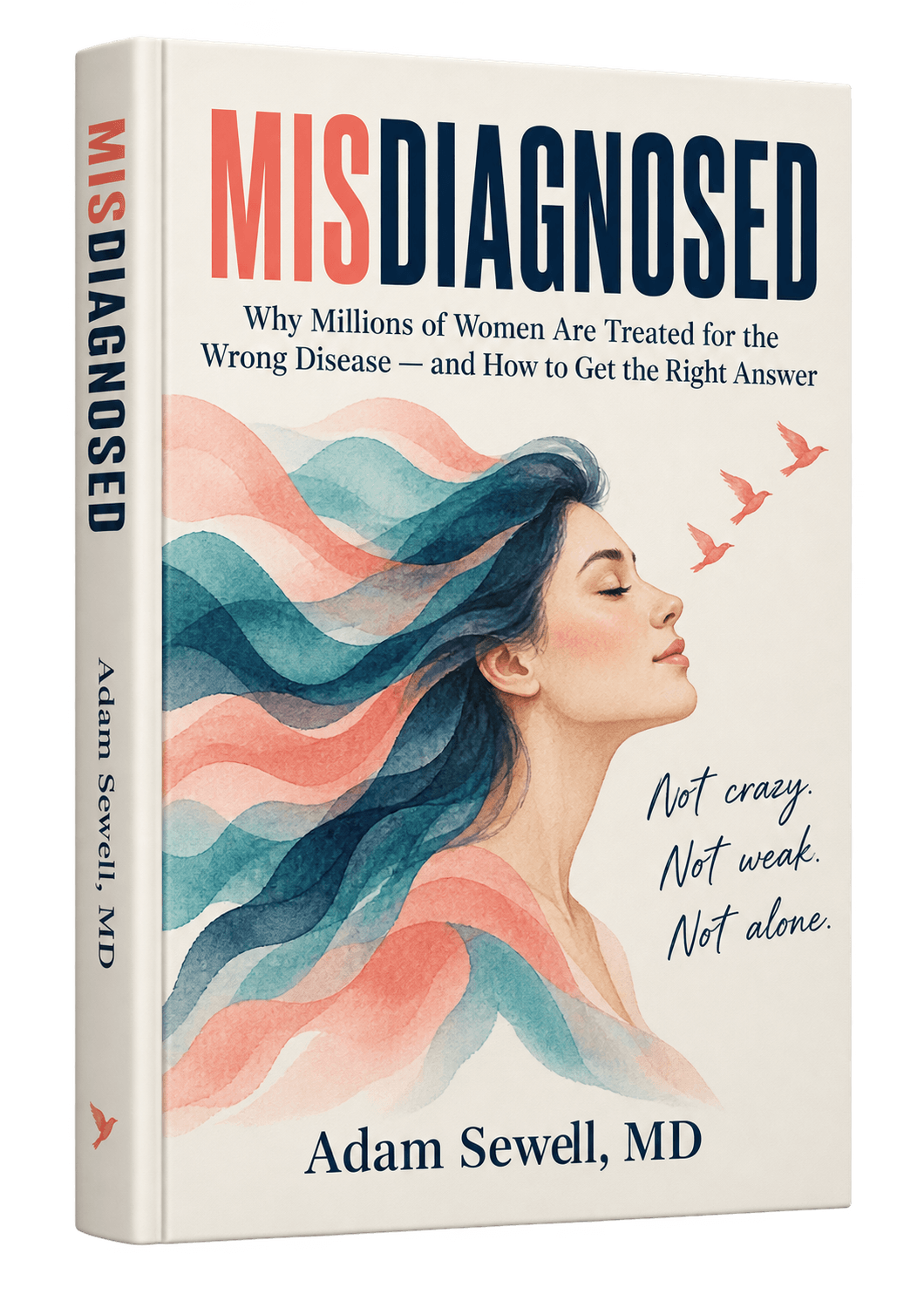
Because these signs span sleep, mood, weight and joints, they're often treated one at a time, or mistaken for stress, anxiety or a thyroid problem. That's the central idea of Dr. Adam Sewell's book Misdiagnosed: midlife symptoms make the most sense when they're looked at together.
Can you get pregnant during perimenopause?
Yes. Ovulation becomes less predictable during perimenopause, but it doesn't stop until menopause. If you don't want to become pregnant, keep using contraception until your clinician confirms you've reached menopause. For many women, low-dose birth control has a second benefit in perimenopause: it can steady irregular periods and ease hot flashes.
Perimenopause vs. menopause: why the difference matters
Knowing whether you're in perimenopause or past menopause shapes your care. In perimenopause, you still need contraception, irregular bleeding has different causes to rule out, and treatments are chosen with your still-active cycle in mind. After menopause, any vaginal bleeding is a reason to see a clinician promptly.
The good news: you don't have to just wait it out. Hormone therapy, newer non-hormonal medications, and sleep and lifestyle support can all help. In November 2025, the FDA announced removal of the long-standing "black box" warnings on menopause hormone therapy, which has opened up more conversations about options. The right choice depends on your age, symptoms and health history.

When to talk to a clinician
Book a visit if perimenopause symptoms are affecting your sleep, work, mood or relationships. Ask about:
Whether your symptoms fit perimenopause, or point to something else, such as thyroid changes
Which labs make sense to rule out look-alikes
Your options for symptom relief, hormonal and non-hormonal
Contraception that fits this stage
See a clinician promptly for very heavy bleeding (soaking a pad or tampon every hour or two), periods less than three weeks apart, bleeding after sex, or any bleeding after 12 months without a period. If you're having thoughts of harming yourself, call or text 988 in the US any time.
Frequently asked questions
What is perimenopause?
Perimenopause is the transition before menopause, when the ovaries gradually produce hormones less predictably and periods become irregular. It usually begins in the 40s, lasts about four years on average, and ends at menopause, after 12 consecutive months without a period.
What age does perimenopause start?
Perimenopause most often starts in the mid-40s, and some women notice changes in their late 30s. Family history, smoking and certain medical treatments can make it start earlier.
How long does perimenopause last?
Perimenopause lasts about four years on average, but it can range from a few months to around ten years. It ends once you've gone 12 months without a period, though hot flashes can continue afterward.
What are the stages of perimenopause?
Early perimenopause is marked by cycle lengths that vary by a week or more. Late perimenopause is marked by skipped periods, with gaps of 60 days or more, when hot flashes and night sweats become more common.
What's the difference between perimenopause and menopause?
Perimenopause is the years-long transition when hormones fluctuate and periods become irregular. Menopause is a single point in time: 12 consecutive months without a period, reached at about age 51 on average in the US.
Can you get pregnant during perimenopause?
Yes. Ovulation becomes irregular but continues until menopause, so pregnancy is still possible. Use contraception until your clinician confirms you've reached menopause.
Ready for answers that fit?
Perimenopause is a normal stage of life, but that doesn't mean you have to push through it alone. Start with our free Whole-Picture Check, or get started with a licensed clinician who looks at the whole picture.
This article is for education only and isn't a substitute for individualized medical care.
Sources
Mayo Clinic: Perimenopause, diagnosis and treatment
Harlow et al., Executive summary of the Stages of Reproductive Aging Workshop + 10 (STRAW+10), Menopause, 2012
Avis et al., Study of Women's Health Across the Nation (SWAN), JAMA Internal Medicine, 2015: duration of hot flashes and night sweats
US Department of Health and Human Services: FDA initiates removal of black box warnings from menopausal hormone therapy products (Nov 2025)
The Menopause Society: 2023 nonhormone therapy position statement